An RPG, or role-playing game, is a genre where you take on the role of a character and make decisions that shape the story, outcomes, and how your character grows. This page covers the core traits that define RPGs, how they’re different from other game genres, the main subgenres with current examples, and how to tell whether a specific game actually qualifies as an RPG. It covers both tabletop formats like Dungeons & Dragons and video game formats like The Witcher 3. By the end, you’ll know what makes a game an RPG and which type might be right for you.
Core Characteristics That Define RPG Games
What makes a game an RPG goes beyond surface features like leveling systems or fantasy settings. The four characteristics below form the foundation of the genre. Games that show three or more of them typically qualify as true RPGs, rather than action games that just borrow a few RPG mechanics.
Character Role Assumption and Identity
In RPGs, you don’t just control a character. You inhabit a specific identity with personality traits, a backstory, and motivations that shape how you interact with the world. That’s different from games where the character is basically a blank stand-in for the player with no real identity of their own.
- Geralt in The Witcher 3 has a defined personality, relationships, and moral code that you navigate rather than build from scratch
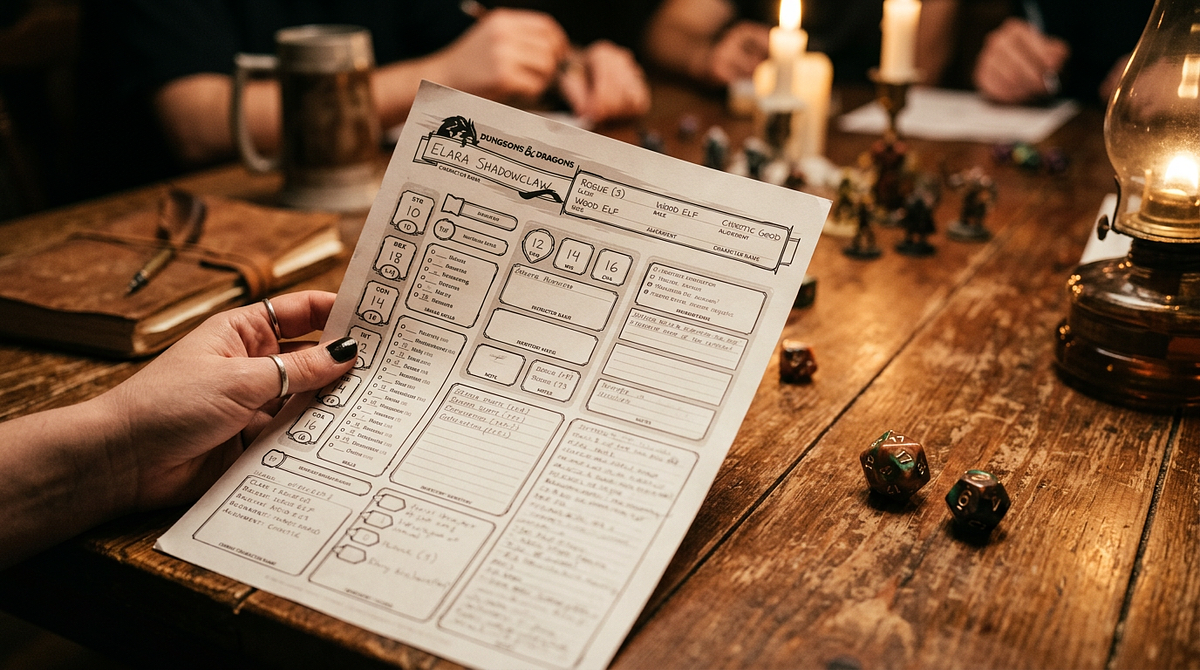
- Custom D&D characters start with player-chosen backgrounds, personality traits, and ideals that shape roleplaying decisions
- Cloud Strife in Final Fantasy VII is a fully realized character whose identity you explore through the story
Meaningful Choice and Consequence Systems
RPGs stand out because your decisions create real impacts on the story, your relationships with other characters, or the state of the world. These aren’t simple pass-or-fail moments. They’re branching paths where what you choose can fundamentally change your experience in ways that stick.
- Mass Effect’s dialogue trees determine which crew members survive, which factions side with you, and how the galactic conflict ends
- Baldur’s Gate 3 has hundreds of branching story paths where early decisions ripple through the entire campaign
- Tabletop D&D campaigns shift based on player choices, with Game Masters adjusting storylines on the fly when players go in unexpected directions
Character Progression and Development
In RPGs, character growth goes beyond unlocking new moves. Progression systems change how your character handles challenges and expand what they’re capable of in measurable ways. That said, progression alone doesn’t make something an RPG. It needs to work alongside the other core traits to count.
- Elden Ring’s leveling system lets you specialize in strength-based melee, magic, or hybrid builds that completely change how you approach combat
- D&D experience points unlock new class features, spells, and abilities that open up solutions that weren’t possible before
- Persona 5’s social stats (knowledge, charm, guts) gate access to relationships and story content beyond just combat abilities
Narrative-Driven Gameplay Structure
In RPGs, story and character development are the core of the game, not decoration around mechanical challenges. The narrative is woven into the systems, so understanding character motivations, world lore, and relationships actually matters for how you play.
- Disco Elysium builds its entire game around dialogue and internal thought processes, with skills shaping conversation options and investigation paths
- Dragon Age party relationships affect combat effectiveness, story outcomes, and which quests are available based on how those relationships develop
- Tabletop RPG sessions put collaborative storytelling first, with combat and skill checks serving the story rather than existing as isolated challenges
Games that show three or four of these traits typically qualify as RPGs. Games with only one or two fall into the “action games with RPG elements” category. Think of the progression systems in Assassin’s Creed: they’re there, but the game lacks meaningful narrative choice to back them up.
Tabletop RPGs vs. Video Game RPGs: Key Differences
Tabletop and video game RPGs share the same core traits: character role-playing, meaningful choices, and a focus on narrative. But they deliver those experiences through very different formats. Understanding those differences helps explain why both deserve the RPG label despite feeling so distinct.
| Aspect | Tabletop RPGs | Video Game RPGs |
|---|---|---|
| Medium | Physical (dice, character sheets, rulebooks) | Digital (consoles, PC, mobile) |
| Game Master | Human GM interprets rules and narrates | Programmed AI/system enforces rules |
| Player Freedom | Unlimited creative options within setting | Limited to programmed choices and mechanics |
| Social Dynamic | Face-to-face collaborative storytelling | Solo or online multiplayer experiences |
| Rules Flexibility | GM can modify or ignore rules as needed | Fixed rule systems with rare exceptions |
| Preparation Required | GM prep, player character creation | Minimal — the game provides structure |
When Tabletop RPGs Excel
Tabletop RPGs offer a level of creative freedom and social interaction that no video game can fully replicate. A human Game Master can respond to player creativity in real time, creating moments that simply can’t be programmed.
- Unlimited player agency: attempt any action you can imagine within the setting, from negotiating with villains to inventing solutions the rulebook never anticipated
- Storytelling that adapts instantly to player choices, with GMs adjusting plots, NPCs, and challenges based on whatever the players decide to do
- Real social bonds built through collaborative storytelling, with inside jokes and shared memories that come out of group play
- Lower cost than gaming hardware: a core rulebook and some dice can give you hundreds of hours of entertainment
When Video Game RPGs Excel
Video game RPGs are more accessible and more polished than tabletop formats. Professional development teams build experiences you can jump into right away, with high-quality visuals and audio to match.
- No rule-learning or schedule coordination required: you can start playing immediately
- Professional voice acting, orchestral soundtracks, and cinematic visuals that bring worlds to life
- Complex combat and progression systems handled automatically by the software, so you’re not doing mental math mid-fight
- Solo play options for people without a gaming group or who prefer to go at their own pace
A lot of gamers enjoy both formats for different reasons: tabletop for social creativity, video games for polished solo adventures. Neither is objectively better. They just serve different needs.
Types of RPG Games: Subgenres Explained
The RPG genre has grown into a range of subgenres, each putting its own spin on the core traits. Knowing these categories can help you figure out which kind of RPG experience you’re actually looking for, though plenty of modern games mix elements from multiple subgenres.
Action RPGs (ARPGs)
Action RPGs combine real-time combat with RPG progression and story elements, sitting somewhere between pure action games and traditional turn-based RPGs. These games ask you to think about both your reflexes and your character build.
- Elden Ring: open-world exploration with challenging real-time combat and deep character build customization through stats and equipment
- The Witcher 3: story-driven adventure with real-time swordplay, alchemy systems, and branching narrative choices
- Diablo IV: loot-focused dungeon crawler with fast-paced combat and endless gear progression
- Monster Hunter Rise: cooperative action built around hunting massive creatures, with deep weapon mastery and gear crafting
Japanese RPGs (JRPGs)
JRPGs tend to be story-heavy experiences with turn-based or menu-driven combat, more linear narratives, and anime-inspired art styles. They put emotional storytelling and character development front and center, rather than giving players a lot of open-ended choice.
- Final Fantasy XVI: cinematic storytelling with action-oriented combat, showing how far the series has moved from its turn-based roots
- Persona 5 Royal: social simulation blended with dungeon crawling, where building relationships unlocks combat abilities
- Dragon Quest XI: traditional turn-based combat with an epic quest narrative and classic JRPG design
- Octopath Traveler: retro-inspired pixel art visuals paired with modern turn-based combat mechanics
Massively Multiplayer Online RPGs (MMORPGs)
MMORPGs are persistent online worlds where thousands of players adventure, team up for group content, and compete for resources at the same time. They put more weight on social interaction and endgame content than on self-contained stories.
- Final Fantasy XIV: story-rich MMORPG with group dungeons, raids, and an active roleplaying community
- World of Warcraft: the genre-defining fantasy MMORPG, with two decades of content across multiple expansions
- The Elder Scrolls Online: open-world exploration with flexible character builds and quest design that works well for solo players
- Guild Wars 2: world events that shift based on player participation and server-wide cooperation
Tactical/Strategy RPGs
Tactical RPGs put the focus on grid-based or strategic combat where positioning, terrain, and planning matter just as much as your character’s stats. These games reward careful thinking over quick reflexes or grinding.
- Fire Emblem: Three Houses: character relationships and recruitment choices shape the strategic grid-based battles
- XCOM 2: squad-based tactical combat with permanent death, which makes every decision feel like it has real stakes
- Divinity: Original Sin 2: environmental interaction and party synergy, with elemental combinations adding tactical depth
- Triangle Strategy: political intrigue narrative combined with tactical grid combat and branching story paths
Western RPGs (WRPGs) and CRPGs
Western RPGs put player choice, character customization, and moral ambiguity ahead of linear storytelling. CRPGs (Computer RPGs) usually refer to isometric, party-based games inspired by tabletop systems, though the two terms overlap quite a bit.
- Baldur’s Gate 3: a D&D-based CRPG with deep choice and consequence systems that touch every part of the campaign
- The Elder Scrolls V: Skyrim: open-world sandbox with freeform character building and exploration-driven gameplay
- Fallout: New Vegas: post-apocalyptic RPG with faction-based story branches and skill-check dialogue options
- Disco Elysium: dialogue-focused detective RPG with no traditional combat, where your internal thoughts and skills shape the investigation
Modern RPGs increasingly mix subgenre elements, so strict categorization matters less than knowing which traits each subgenre tends to emphasize. A game can combine action combat with JRPG-style storytelling, or tactical gameplay with Western-style choice systems.
How to Identify If a Game Is an RPG
Genre lines have gotten blurry in modern gaming. Action games have adopted progression systems, and RPGs have picked up real-time combat. This framework can help you figure out whether a game is genuinely an RPG or just borrows a few RPG mechanics as secondary features.
The RPG Identification Checklist
Run any game through these questions to get a sense of where it falls. Games that meet three or more of these typically qualify as RPGs rather than other genres with borrowed mechanics.
- Does the game center on playing a specific character role with a distinct identity, not just controlling a generic avatar?
- Do your choices meaningfully impact story outcomes, character relationships, or the state of the world, beyond simple success or failure?
- Does character progression fundamentally change what you can do in the game through stats, skills, or abilities, rather than just unlocking new areas?
- Is the narrative woven into the core gameplay systems, rather than existing as separate cutscenes or text?
- Do three or more of these elements form the game’s main focus, rather than being secondary features tacked onto another genre?
Games that meet three to four of these criteria are typically RPGs. Games with one or two fall into the “action/adventure games with RPG elements” category. They borrow the mechanics without fully committing to what the genre is actually about.
Common Genre Confusion Cases
These popular games come up a lot in debates about RPG classification. Applying the checklist above makes it easier to see where they actually land.
- The Legend of Zelda series: Action-adventure with RPG elements. Progression exists through heart containers and equipment, but the games lack character role-playing identity and meaningful narrative choice, which are what actually define RPGs.
- Elden Ring: Action RPG. It combines challenging real-time combat with deep character building, environmental storytelling, and build customization that genuinely changes how you play.
- Assassin’s Creed series: Action-adventure with RPG elements. Recent entries added skill trees and dialogue options, but your choices rarely affect story outcomes and the character’s identity stays fixed.
- Hades: Roguelike with RPG elements. It has character interactions and between-run progression, but the permadeath structure and action-focused gameplay put it outside traditional RPG design. If you enjoy shorter, more contained play sessions, exploring game genres built for short play sessions can help you find titles that fit your schedule alongside longer RPGs.
Genre labels matter less than knowing what kind of experience you want. Use the core characteristics framework to evaluate games rather than getting hung up on strict definitions. If a game delivers the role-playing, choice, and narrative you’re after, the label is secondary.
Starting Your RPG Journey: Beginner Recommendations
Knowing what RPGs are is just the first step. Actually playing one means picking an entry point that fits your interests and what you have available. Both tabletop and video game formats have solid options for newcomers.
Getting Started with Tabletop RPGs
Tabletop RPGs take more setup than video games, but they offer creative freedom that’s hard to match once you get going. The goal at the start isn’t to master every rule. It’s to find the right group and system and just start playing.
- Pick a beginner-friendly system. The D&D 5th Edition Starter Set comes with guided adventures and simplified rules. Quest or Kids on Bikes are even more accessible if you want something with minimal mechanics.
- Get three to five friends who are willing to learn alongside you, with one person stepping up as Game Master to narrate and referee.
- Run a pre-written adventure module to learn the rules through play rather than reading entire rulebooks first. Starter sets include everything you need for your first sessions.
- In early sessions, focus on storytelling and having fun rather than getting every rule right. Experienced players often bend or ignore rules when it makes the story better.
- If you don’t have a local group, check out communities like r/lfg or Roll20. Virtual tabletop platforms let you play remotely with people from anywhere.
Getting Started with Video Game RPGs
Video game RPGs are easy to jump into, and they come in a range of complexity levels. Start with something approachable that matches how you like to play before moving on to more complex systems. If you’re new to PC gaming in general, this guide to the best PC games for beginners covers accessible titles across multiple genres, including RPGs, that are well-suited to players just getting started.
- Start with accessible titles. Pokémon offers turn-based simplicity. Skyrim gives you open-world freedom without a lot of mechanical complexity. Persona 5 has a guided structure with clear objectives.
- Use difficulty settings that let you focus on the story while you’re still learning the systems. Most modern RPGs have a “story mode” option built in.
- Don’t feel like you need to do every side quest on your first playthrough. Stick to the main story to get a handle on the core mechanics before branching out.
- Use online guides when you’re stuck on something specific, but try to avoid spoiling major story beats. The story is a big part of what makes RPGs worth playing.
- Try both action RPGs and turn-based games to figure out which style clicks for you.
The best RPG for a beginner is whichever one grabs your interest enough to push through the early learning curve. If a game isn’t clicking, move on. The genre has enough variety that something will fit.
Understanding RPG Genre Evolution and Modern Gaming
RPG elements have spread across modern gaming. Action games have picked up progression systems, and open-world titles have added choice mechanics. That genre-blending makes “pure” RPG classification less useful than just knowing which core traits matter most to you, whether that’s narrative choice, character building, or immersive role-playing.
Use the four core characteristics framework when you’re evaluating games rather than relying on what the marketing says. If you want to go deeper, subgenre guides for action RPGs, JRPGs, or tactical RPGs can help you find titles that match your preferred style and how much time you want to put in.
Frequently Asked Questions About RPG Games
What does RPG stand for in gaming?
RPG stands for “role-playing game,” a genre where you take on the role of a character in a fictional setting and make decisions that shape the story and its outcomes. The term covers both tabletop games like Dungeons & Dragons and video games like Final Fantasy or The Witcher.
Are all games with leveling systems considered RPGs?
No. Character progression alone doesn’t make a game an RPG. True RPGs combine progression with character role-playing, meaningful choice systems, and narrative-driven gameplay as core features, not secondary mechanics.
Can you play RPGs alone or do you need a group?
Video game RPGs are built for solo play. Tabletop RPGs traditionally need three to six players, including a Game Master. That said, solo tabletop RPG systems and online platforms now make single-player tabletop experiences possible.
What’s the difference between RPG and MMORPG?
MMORPGs (Massively Multiplayer Online RPGs) are video game RPGs set in persistent online worlds where thousands of players interact at the same time. Traditional RPGs are single-player or small-group experiences with self-contained stories.
Do RPGs always have fantasy settings?
No. Fantasy is the most common RPG setting, but the genre covers science fiction (Mass Effect, Starfield), horror (Call of Cthulhu), cyberpunk (Cyberpunk 2077), and contemporary settings (the Persona series). The setting has nothing to do with whether a game qualifies as an RPG.
How long does it take to complete an RPG?
It varies a lot. Video game RPGs can run anywhere from 20 to 100-plus hours, while tabletop campaigns often unfold over months of weekly sessions. The real variable isn’t the game itself but how deep you want to go. If you’re weighing your options, using a practical framework to choose your next game can help you find something that fits your schedule and playstyle.