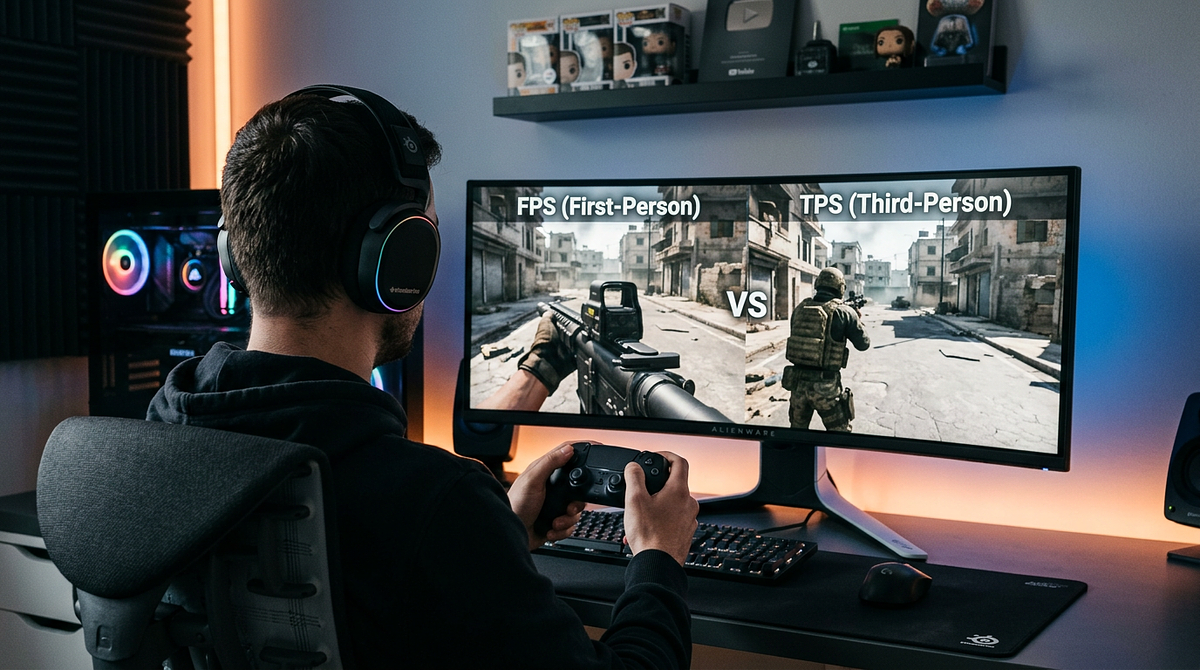
FPS vs TPS comes down to two camera perspectives in shooter games: first-person, where you see through the character’s eyes, and third-person, where the camera sits behind and above the character. This page covers how each perspective affects aiming, movement, cover mechanics, and overall gameplay feel, with examples from well-known titles. By the end, you’ll have a clear sense of which perspective suits your playstyle and what to expect from each when choosing your next game.
What Defines FPS and TPS Camera Perspectives
The core difference between these two perspectives is where the camera sits and how that changes your experience of the game. It goes well beyond visual preference. Camera placement determines what information you can access, how you interact with environments, and which tactics work in combat.
Camera Position and Field of View
FPS games put the camera at your character’s eye level, mimicking human vision. You see exactly what your character sees: weapons, hands, and whatever is directly ahead. Your peripheral vision is limited to the edges of your screen, which creates a narrow view that feels immersive but cuts down on environmental awareness.
TPS games place the camera behind and slightly above your character, usually over the shoulder. This gives you a wider view that includes your character model, your immediate surroundings, and areas just outside your direct line of sight. You gain better spatial awareness, but there’s a visual gap between where your character stands and where you’re actually looking from.
Information Access and Visibility
Camera placement directly controls what tactical information you can see during a match. In FPS games, you’re limited to your direct line of sight. You can’t see around corners, behind cover, or spot enemies coming from blind spots without physically turning your character. Threats can get close without you noticing until they’re right in front of you.
TPS games show you more: your character’s position relative to cover, enemies approaching from wider angles, and hazards outside your direct sightline. You can spot threats from areas that would be completely invisible in first-person, which changes how you gather information and react to danger. You can watch multiple approach angles at once without constantly rotating the camera.
Character Representation and Immersion
FPS games don’t show your character at all, just your weapon and hands. This creates strong immersion by removing the visual barrier between you and the game world. It feels like you are the character, not someone controlling one. The trade-off is that you lose visual feedback about your character’s status, appearance, and position in space.
TPS games keep your character visible at all times, so you can see your customization choices, animations, and body language. That pulls you back a bit from full immersion since you’re clearly watching a character rather than being one. But it gives you useful feedback about movement, positioning, and what your character is doing. A lot of players genuinely enjoy seeing their customized character and gear during play.
How Aiming Mechanics Differ Between Perspectives
Camera perspective changes how targeting works in a pretty fundamental way. The aiming challenges in each perspective are different enough that many players find one far more natural than the other, and it affects accuracy, learning curves, and how well each perspective holds up in competitive play.
Direct Line of Sight vs Camera Offset
In FPS games, your crosshair shows exactly where your bullets will go. The camera sits at weapon level, so there’s a direct, 1:1 relationship between where you’re aiming and where shots land. If your crosshair is on target, you hit.
TPS games introduce camera offset. Your viewing angle sits several feet behind and above your character, while bullets still come from your weapon. This creates parallax: a gap between where you appear to be aiming from the camera’s position and where shots actually originate. At close range, this can cause you to miss even when your crosshair looks lined up, so you have to mentally adjust for the displacement.
Aiming Difficulty and Precision Challenges
| Aiming Factor | FPS Mechanics | TPS Mechanics |
|---|---|---|
| Crosshair accuracy | Direct representation of bullet trajectory | Offset requires mental adjustment for parallax |
| Close-range targeting | Highly accurate with minimal adjustment | Challenging due to camera-weapon displacement |
| Long-range precision | Straightforward alignment | Parallax effect diminishes with distance |
| Learning curve | Intuitive for new players | Requires practice to compensate for offset |
| Competitive consistency | High precision ceiling | Additional skill requirement for mastery |
Reticle Systems and Aim Assist
FPS games typically use a centered reticle that stays fixed at the middle of your screen. Weapon spread and recoil affect accuracy, but the direct sightline means what you see is what you get. You can focus entirely on tracking targets and managing recoil without worrying about perspective-related complications.
TPS games often use reticles that shift based on your character’s position, cover state, and camera angle. Many TPS titles also include aim-assist systems to help compensate for the parallax problem, especially on consoles. Some games, like The Division, offer an over-the-shoulder aiming mode that temporarily moves the camera closer to your weapon for precision shots, while keeping the third-person view for general movement.
Strategic Advantages and Competitive Balance
The perspective you play in creates genuinely different strategic opportunities, and those differences go beyond personal preference. They help explain why certain genres favor specific camera angles and how perspective affects competitive fairness.
Situational Awareness and Information Advantage
TPS games give players a built-in information advantage through the wider field of view. You can spot enemies around corners without exposing yourself, watch multiple approach angles at once, and stay aware of threats outside your direct sightline. This creates “camera peeking” situations where a TPS player can gather tactical information that someone in the same physical position simply couldn’t access.
FPS games keep information access equal across all players. Everyone has the same visibility limitations based on where their character is looking. You can’t gather intelligence without physically exposing yourself, which turns reconnaissance into a risk-reward decision. This puts more weight on reaction speed and mechanical skill, rewarding players who can process threats quickly once they appear.
Cover Mechanics and Tactical Positioning
TPS games are well-suited to cover-based gameplay because the camera lets you see exactly how your character lines up with cover. You can watch enemy positions while staying protected, plan movements between cover points, and set up flanks with a clear picture of the space around you. This supports a more deliberate, tactical style where you gather information before committing to an engagement.
FPS games handle cover differently. You judge protection based on environmental geometry and experience rather than visual confirmation. This pushes players toward more aggressive peeking strategies and angle-holding tactics. The focus shifts to pre-aiming common positions and direct confrontation rather than extended cover exchanges. If you’re deciding which input method best complements this style of play, understanding how controllers and keyboard-and-mouse setups compare for different game genres can help you make a more informed choice.
Competitive Fairness Debates
The competitive community has debated whether TPS camera advantages create unfair information asymmetry. Critics argue that seeing around corners without exposure undermines competitive integrity. Supporters say that when everyone has access to the same mechanics, balance is maintained. Games like PUBG address this by offering separate FPS and TPS matchmaking modes, letting players choose the competitive environment they prefer.
FPS games dominate professional esports specifically because everyone works with the same information. The direct sightline removes camera-based advantages, so outcomes come down to aim, positioning, and game sense rather than perspective exploitation. That’s why major competitive titles like Counter-Strike, Valorant, and Call of Duty all use first-person perspectives.
Popular Games and Perspective Implementation
Looking at how successful games use each perspective shows why developers make the camera choices they do. These decisions reflect how perspective supports core mechanics, target audiences, and competitive goals.
Dominant FPS Titles and Design Philosophy
Call of Duty is a good example of fast-paced FPS design. The direct sightline puts the emphasis on reaction speed and mechanical aim. You encounter enemies, react instantly, and move to the next fight. Limited visibility creates constant tension and rewards players who stay aware through sound cues and the minimap.
Valorant shows what tactical FPS design looks like. It combines precise gunplay with ability-based strategy. The first-person perspective keeps competitive play fair by removing camera-based information advantages, while slower movement and ability mechanics add strategic depth without taking away the reaction-based core. The direct sightline makes precise angle-holding and pre-aiming viable, which is central to how competitive Valorant is played.
Leading TPS Games and Perspective Benefits
Fortnite uses third-person perspective to support its building mechanics. The wider field of view lets players track structure placement, watch multiple opponents during build battles, and stay oriented in vertically complex environments that would be disorienting in first-person. The camera angle is genuinely tied to how the building system works.
The Division 2 uses TPS to support cover-based tactical gameplay. Players can watch enemy positions while staying protected, plan coordinated movements between cover points, and execute flanking maneuvers. The perspective fits the game’s focus on positioning and tactical decision-making over pure mechanical aim, which makes combat feel more methodical.
Gears of War built its identity around TPS cover mechanics. The camera angle gives players feedback on the signature cover-to-cover movement system, letting them see character animations, cover transitions, and spatial relationships that define how the franchise’s combat flows.
Hybrid Games Offering Both Perspectives
Some games use both perspectives to serve different gameplay needs. PUBG offers separate FPS and TPS matchmaking modes with distinct strategies in each, so players can choose their preferred competitive setup. Fortnite defaults to TPS but switches to first-person when aiming down sights, giving precision aiming without sacrificing situational awareness. GTA Online lets players switch perspectives freely, so they can choose between immersion and tactical advantage depending on the situation.
Choosing the Right Perspective for Your Play Style
Choosing between FPS and TPS comes down to what you want from a shooter: immersion, competitive play, motion sensitivity, or strategic depth. Knowing how each perspective fits different goals makes it easier to pick the one that works with your natural style rather than against it.
Immersion vs Spatial Awareness Priority
Go with FPS if you want to feel directly connected to the game world. The first-person view removes the visual barrier between you and the environment, creating intense, immediate experiences where you react instinctively to threats. It suits players who value atmospheric tension and realistic combat over tactical planning.
Go with TPS if you want comprehensive environmental awareness and the ability to see your character’s customization. The third-person camera gives you strategic information about your surroundings, your character’s position, and approaching threats that first-person simply can’t offer. It suits players who enjoy tactical planning, character expression, and strategic positioning.
Competitive Play and Skill Expression
FPS games reward mechanical aim directly, and uniform information access keeps competition fair. The faster, reaction-based gameplay rewards reflexes and precision, and the established esports scene supports competitive play at a high level. If you’re aiming for high-level competitive gaming, FPS titles dominate the professional circuit.
TPS games put more weight on strategic positioning and awareness. Information gathering becomes a core skill rather than a side consideration. The slower, more deliberate decision-making suits players who prefer tactical thinking over pure reflexes. Your character’s customization stays visible during competitive play, which appeals to players who care about personal expression alongside performance.
Motion Sensitivity and Accessibility
FPS games can trigger motion sickness in some players because of rapid camera movements, head bobbing, and the narrow field of view. The direct perspective amplifies visual motion, especially during fast turns or vertical movement. If FPS games make you feel nauseous, TPS perspectives usually help because the pulled-back camera is more stable and less disorienting.
TPS games are generally more accessible for players sensitive to motion sickness, though the camera can still cause issues during rapid movements or tight camera angles. The external perspective gives players a stable visual reference that helps with orientation during complex or fast-paced combat. If you’re still exploring which types of games suit you best, a guide to beginner-friendly PC games organized by genre can help you find titles that match your experience level and preferred perspective.
Making an Informed Decision Between FPS and TPS Gameplay
The camera perspective you choose shapes everything about your shooter experience, from how you process information to which skills you build. FPS perspectives reward mechanical precision and reaction speed through direct sightlines. TPS cameras put more weight on tactical awareness and strategic positioning through a wider view of the environment. Neither is objectively better, but one will probably fit your natural strengths and preferences more than the other. A good starting point is testing both in free-to-play titles like Fortnite (TPS) and Valorant (FPS) to feel the mechanical differences firsthand. Pay attention to which feels more natural during combat and which creates the kind of engagement you’re actually looking for.
Frequently Asked Questions About FPS vs TPS
Can switching between FPS and TPS perspectives improve my overall gaming skills?
Yes. Playing both perspectives builds complementary skills. FPS sharpens mechanical aim and reaction speed, while TPS builds spatial awareness and tactical positioning. Many competitive players practice both to develop well-rounded shooter fundamentals that carry over across different game types.
Why does aiming feel harder in third-person shooters compared to first-person games?
TPS aiming requires you to compensate for camera offset (parallax). Your viewing angle sits behind your character, but bullets come from the weapon’s position. That gap between where you appear to be aiming and where shots actually land is most noticeable at close range, and it takes mental adjustment that FPS games don’t require.
Do professional esports competitions use FPS or TPS games more frequently?
FPS games dominate professional esports because the perspective keeps competition fair through equal information access. Major titles like Counter-Strike, Valorant, and Call of Duty all use first-person perspectives to put the focus on mechanical skill rather than camera-based advantages, which makes for cleaner competitive integrity.
Which perspective is better for new gamers just starting with shooter games?
TPS games tend to be more forgiving for beginners because the wider field of view gives better environmental awareness, and seeing your character helps with spatial orientation. That said, FPS aiming mechanics are often more intuitive once you understand the direct sightline principle. The best choice really depends on whether you’d rather have better awareness or simpler aiming to start with. If you’re unsure which game to try first, using a practical framework for choosing your next game based on your mood, time, and preferences can make the decision much easier.
Are there any shooters that successfully combine both FPS and TPS perspectives?
PUBG offers separate FPS and TPS matchmaking modes, while Fortnite defaults to TPS but switches to first-person when aiming down sights. GTA Online and Minecraft allow free perspective switching, though competitive balance varies depending on how it’s set up. These hybrid approaches let players choose their preferred experience or switch based on what the situation calls for.
Does third-person perspective provide unfair advantages in competitive multiplayer?
When every player has the same ability to peek around corners, it’s less an unfair advantage and more a design feature that rewards spatial awareness over reflexes. The real question isn’t fairness. It’s whether that style of play suits you, which makes trying out different perspective modes the most practical way to find your competitive fit.